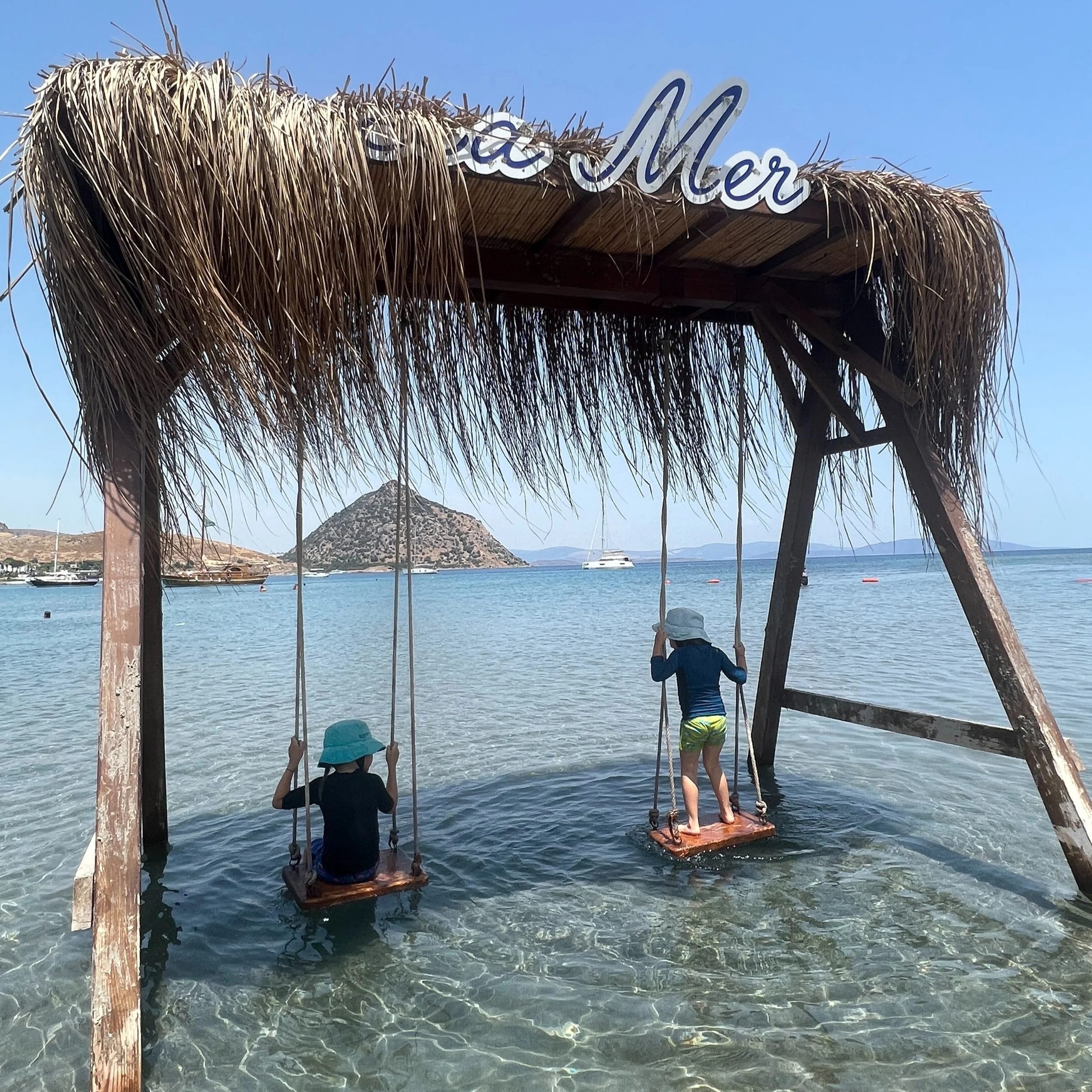
Our oldest was three and a half years old. Our youngest hadn't turned two. We put them on a plane from Singapore to France, drove to a boatyard in La Rochelle, and stepped onto a catamaran that would be our home for the next four years.
Neither of them had ever been on a sailboat before. Neither had we, honestly.
People have strong reactions when you tell them you're uprooting toddlers to live on a boat. Some are enthusiastic. Some think you're selfish. A few look at you like you're describing a crime. The most common response was "they won't remember any of it," as if that somehow makes it pointless.
They might not remember specific moments. But they remember how to be adaptable. They remember how to talk to strangers. They remember that home is wherever we all are, not a postcode.
The first six weeks were difficult
I'm going to be honest about this because nobody was honest with us and it would have helped.
Our eldest missed Singapore, his friends, his routine. He didn't understand that this was home now, and trying to explain it to a kid who hasn't yet grasped the concept of permanence is its own special kind of heartbreak!
Our youngest was easier in some ways because she was two and didn't have as many attachments. The confined space of a boat made everything louder and more intense.
Ben and I were also adjusting, learning to sail, learning to anchor, learning to live in 40 square metres. We were stressed and exhausted and the kids picked up on all of it. Kids always pick up on it.
What helped
Routine. We kept the same daily structure we'd had in Singapore, just in a different setting. Breakfast at the same time. Learning time in the morning. Outdoor play in the afternoon. Bedtime story at seven. The familiarity of the rhythm mattered more than the location.
Both kids had their small box of toys. Small things, but they mattered enormously. We made sure they had their own space on the boat, even though it was tiny. Their berth was theirs. That ownership helped.
Other kids were the biggest thing. Kids don't need shared language or shared background. They need a beach and a bucket. We started actively seeking out anchorages where other sailing families were, and within a month both kids had a social life better than ours.
We also had to lower our expectations. You are sold you will be exploring ancient ruins and snorkelling pristine reefs from week one. In reality, we spent the first month barely leaving the marina/boat because the kids needed stability more than they needed adventure. Accepting that was hard for us, but right for them.
How they changed
By the end of the first year, both kids had learned a staggering amount without a single classroom. Our kids could identify so many species of fish. Count to ten in four languages. They understood tides, weather, maps (not initially but eventually!). They knew how to be quiet at border crossings and patient during long passages.
But the biggest change was emotional. They learned that uncomfortable things pass. That new places become familiar. That missing somewhere doesn't mean you made a wrong choice.
What I'd tell a parent who's worried
Your kids will struggle at first. That's normal and it's not a sign that you made a mistake. The adjustment period is real and it's messy and you'll doubt yourself constantly during it.
But kids are built for adaptation in a way adults aren't. Their world is smaller and more flexible. They don't have careers to mourn or identities tied to postcodes. They just need you, a few familiar things, and other children.
If our kids can go from Singapore to a sailboat in the Med at two and four, your kids can handle a move abroad. They really can!
The harder question is whether you can handle the guilt and uncertainty that comes with it. That's worth talking through before you go. It's one of the things we work through in our coaching sessions, because the emotional side of moving kids is the part most families underestimate.
